Grams to Cups Converter
There’s no single answer to ‘how many grams are in a cup’ — it depends entirely on what you’re measuring. 1 cup of flour is about 125g, but 1 cup of honey is over 300g. Use the converter below, pick your ingredient, and get an exact result.
Select an ingredient and enter a weight in grams to calculate the volume in cups.
Do you want to convert grams to tablespoons or ounces?
Gram Conversion Calculators
You can also convert grams using one of our related converters below.
Grams to Cups Formula
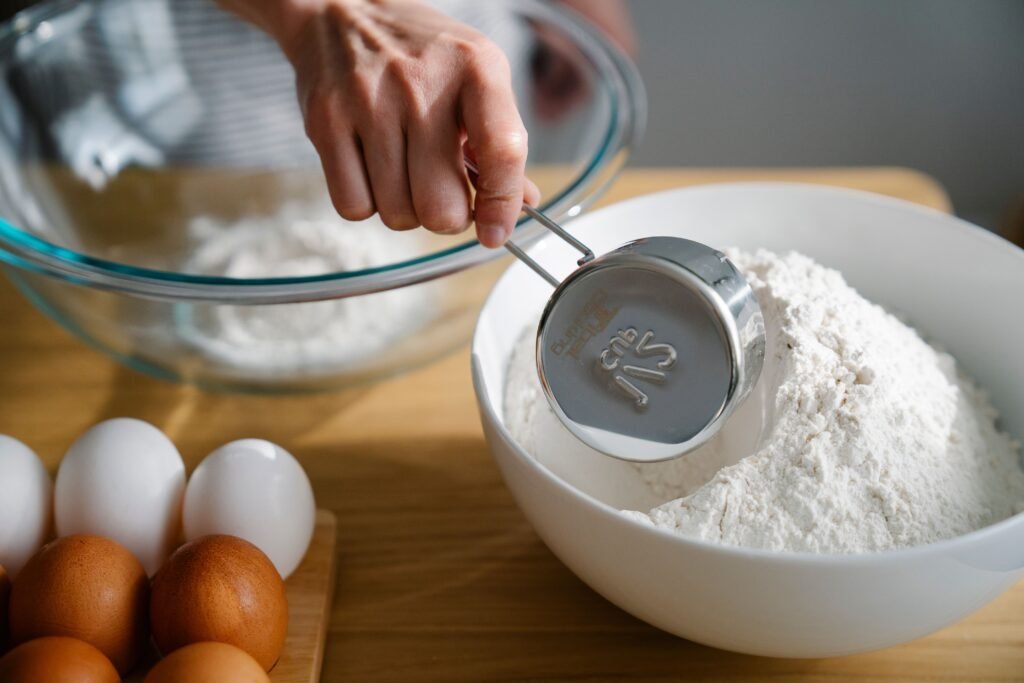
Because grams measure weight and cups measure volume, there’s no fixed conversion between them — it depends on the ingredient’s density. The general formula is:
Cups = Grams ÷ (Ingredient Density × 236.6)
The 236.6 is the number of milliliters in 1 US cup. Density varies by ingredient — flour is light and airy, honey is thick and heavy, so the same 100g of each fills a very different amount of cup space.
Grams to Cups Chart by Common Amounts
See how the same weight converts across different ingredients — this is exactly why the ingredient selector above matters. How Many Cups Is 50 Grams?
How Many Cups Is 50 Grams?
How Many Cups Is 100 Grams?
How Many Cups Is 150 Grams?
How Many Cups Is 200 Grams?
How Many Cups Is 250 Grams?
Steps to Convert Grams to Cups
Here’s how to convert grams to cups manually, without using the tool above.
Step One: Find the Ingredient’s Density
Every ingredient has a different density, so the first step is identifying what you’re converting. Flour, for example, is much less dense than honey — the same weight fills very different amounts of space. Our density chart above covers the most common baking ingredients.
Step Two: Apply the Formula
Once you know the density, divide the weight in grams by the density (in grams per cup) to get the volume in cups:
Cups = Grams ÷ Density (g per cup)
For example, let’s convert 115 grams of all-purpose flour (density: 125 g/cup) to cups:
115 g ÷ 125 g/cup = 0.92 cups
So, 115 grams of all-purpose flour is just under 1 cup.
What Is a Gram?
A gram is a metric unit of mass, equal to 1/1,000 of a kilogram*. It’s abbreviated as “g” — for example, 1 gram is written as 1 g. While technically a measure of mass, the gram is commonly used interchangeably with “weight” in everyday cooking contexts.
What Is a Cup?
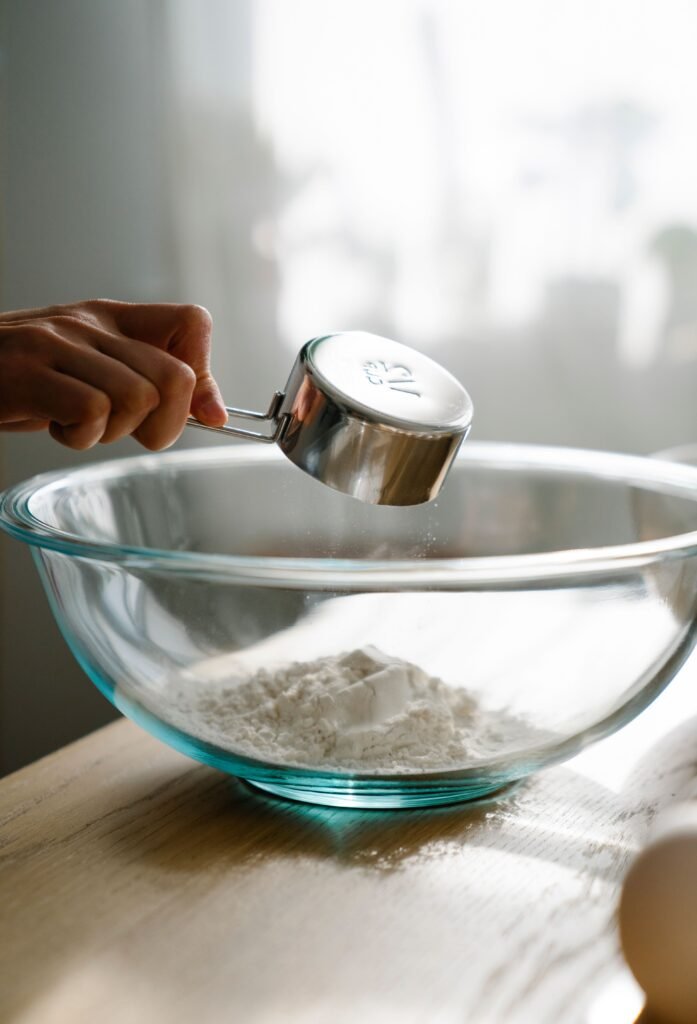
A cup is a unit of volume equal to 16 tablespoons* or 8 fluid ounces*. One US cup equals 236.6 milliliters* — but this isn’t universal. A metric cup (used in Australia and parts of Europe) is 250 mL, and a Japanese cup is only 200 mL. If a recipe doesn’t specify, it’s usually safe to assume US customary cups unless the source is clearly international.
How many grams are in a cup?
It depends on the ingredient. 1 cup of water is about 237g, 1 cup of flour is about 125g, and 1 cup of honey is about 340g — because grams measure weight and cups measure volume, and different ingredients have different densities.
How many grams of flour are in a cup?
1 cup of all-purpose flour is approximately 125 grams, using the standard spoon-and-level method. If you scoop directly with the cup, it can compact and weigh closer to 150g.
How many grams of sugar are in a cup?
1 cup of granulated white sugar is approximately 200 grams. Brown sugar, when packed, is closer to 220 grams per cup due to its moisture content.
Is it more accurate to measure by grams or cups?
Grams (weight) are more accurate than cups (volume) for baking, since a cup measurement can vary depending on how tightly an ingredient is packed. Using a kitchen scale with gram measurements removes that variability entirely.
What if the recipe doesn’t specify the ingredient type?
Default to the most common version: all-purpose flour (120g/cup), granulated white sugar (200g/cup), or salted butter (227g/cup). If context suggests otherwise (like “cake flour” or “brown sugar”), adjust accordingly. When in doubt, the gram measurement is more reliable.
References
- U.S. Food & Drug Administration, Guidance for Industry: Guidelines for Determining Metric Equivalents of Household Measures, {https://www.fda.gov/regulatory-information/search-fda-guidance-documents/guidance-industry-guidelines-determining-metric-equivalents-household-measures}
- U.N. Food and Agriculture Organization, FAO / INFOODS Databases – Density Database Version 2.0, {https://www.fao.org/4/ap815e/ap815e.pdf}
- National Institute of Standards & Technology, Culinary Measurement Tips, {https://www.nist.gov/pml/owm/culinary-measurement-tips}